

Cobalt ores: genesis, resources, uses, and Ukraine’s potential
Cobalt ores are an important source of a strategic metal widely used in high-technology sectors ranging from aerospace engineering to electrochemistry. Modern demand for cobalt is rapidly increasing due to the development of battery energy storage systems, electric transport, and military technologies. This drives the need to reassess the resource potential of cobalt ores, discover new deposits, and optimize extraction technologies for both primary and technogenic raw materials.
Cobalt ores are included in the list of minerals of national importance, approved by Resolution of the Cabinet of Ministers of Ukraine No. 827 of December 12, 1994, as non-ferrous metal ores.
List of minerals of national importance
See the complete classified list of minerals in Ukraine
Go to the listGeneral information
Cobalt (Co) is a chemical element of Group VIII of the periodic table with atomic number 27. In nature, it occurs as a single stable isotope, ⁵⁹Co. Pure cobalt is a silvery metal with a slightly pinkish tint; it is refractory, ferromagnetic, and resistant to atmospheric corrosion. Its melting point is 1495 °C, and its Curie temperature is 1121 °C.
In nature, cobalt is mainly found in sulfide, arsenide, and oxide minerals formed under a wide range of geological conditions—from deep magmatic processes to weathering and oxidation zones. Its occurrence is commonly associated with nickel, iron, and copper, which explains the formation of complex isomorphic mineral structures. The most common cobalt-bearing minerals are listed below:
- Pentlandite — (Fe,Ni,Co)9S8
- Linnaeite — Co3S4
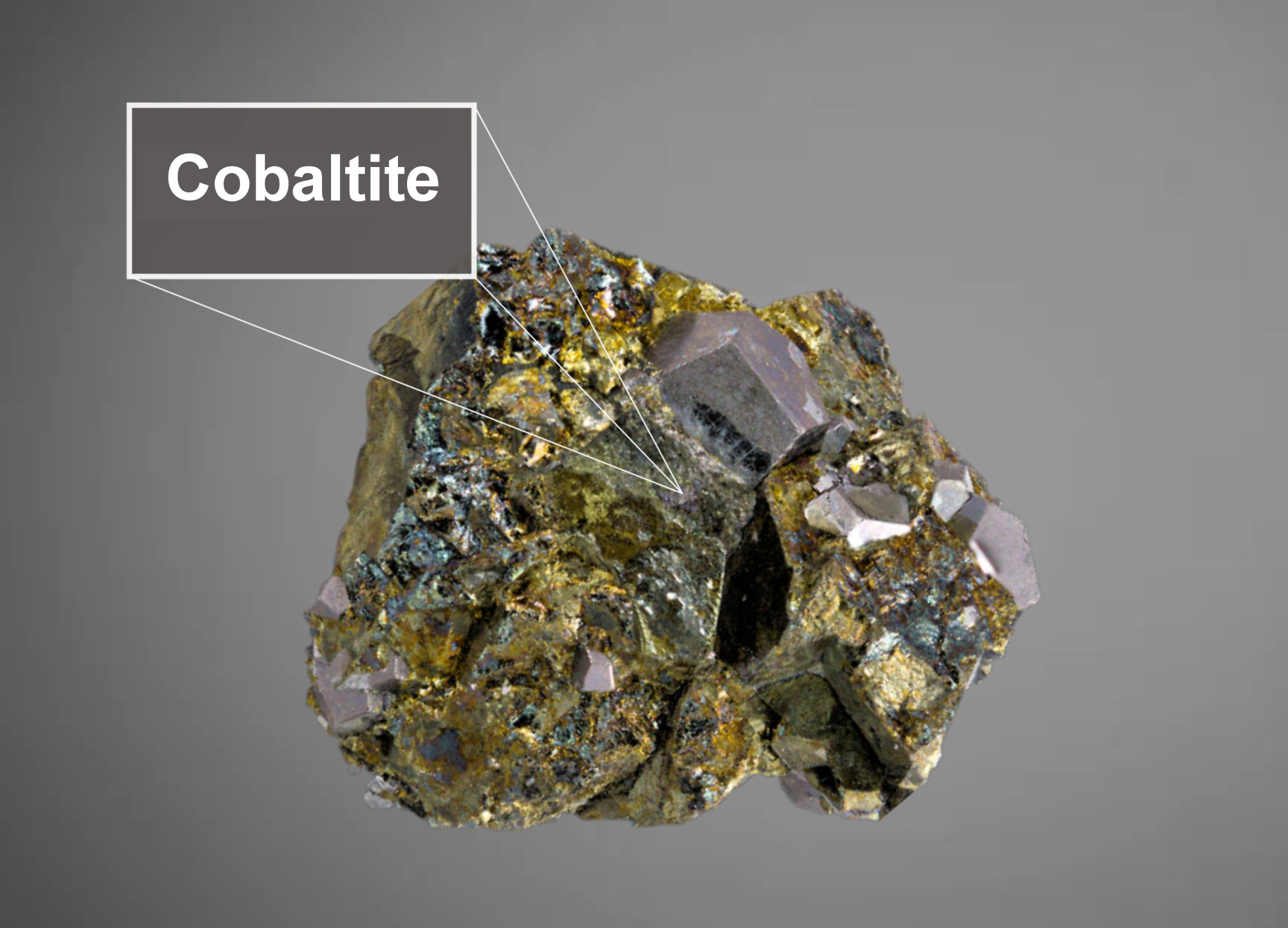
- Cobaltite — CoAsS
- Glaucodot — (Co,Fe)As
- Skutterudite — (Ni,Co)As3
- Safflorite — CoAs2
- Asbolane — (Co,Ni)O2·MnO2·nH2O (weathering zone mineral)
- Erythrite — Co3(AsO4)2·8H2O (oxidized zones)
Deposit types
In nature, cobalt most commonly occurs as an accessory component in nickel deposits; however, under specific geological conditions it can also form independent commercial concentrations. The main genetic types of cobalt deposits include magmatic, hydrothermal, exogenic, and stratiform copper-sandstone deposits.
Magmatic deposits
In sulfide Cu–Ni deposits of liquation origin, cobalt is a consistent companion of nickel. It most often occurs within pentlandite, where it isomorphically substitutes for nickel. In most cases, the Co/Ni ratio in such ores is approximately 1:50–1:60, and less commonly up to 1:30. Cobalt is recovered together with nickel during metallurgical processing at smelting plants.
Weathering crust (exogenic) deposits
This type of deposit forms during lateritic weathering of ultramafic rocks. Cobalt is concentrated in asbolane and cobalt-bearing nontronite—secondary minerals predominantly occurring in the upper horizons of the weathering profile. The cobalt content varies depending on the profile type: in areal settings the Co/Ni ratio may approach 1:1, whereas in linear systems nickel dominates (1:45–1:60). Typical examples include the Yelizavetinske, Sakharinske, and Kempirsayske deposits.
Hydrothermal depositsHydrothermal deposits contain cobalt in the form of arsenides and diarsenides (safflorite, skutterudite, smaltite, chloanthite, niccolite), often accompanied by silver. Ore bodies occur as veins or stockwork systems, typically hosted in skarn, serpentinite, or sedimentary rocks. The ores are polymetallic in composition (Co–Ni, Co–Ni–Ag, etc.). Mineral formation proceeded through several stages, ranging from arsenopyrite–cobaltite assemblages to sulfide–carbonate associations. Well-known examples include Bou Azzer (Morocco), Khovaoksy (Russia), and Eldorado (Canada).
In stratiform deposits, particularly in Zambia and the Democratic Republic of the Congo, cobalt occurs within copper ores, enriching chalcopyrite-bearing horizons. Upsection, bornite zones typically contain lower cobalt concentrations. Mineralization is usually hosted in permeable rocks (sandstones, and less commonly limestones) and is often associated with synclinal structures without a direct connection to igneous intrusions. The main cobalt-bearing mineral is linnaeite (Co₃S₄), from which cobalt is recovered as a by-product.
Globally, the largest share of cobalt reserves is concentrated in laterite deposits (48.5%), followed by stratiform deposits (43.1%), and sulfide magmatic deposits (7.2%). Despite their different origins, most ores are mined through integrated processing, which highlights the importance of cobalt as a valuable by-product metal.
Modern uses
Historically, cobalt has been known since antiquity as a pigment for glass, ceramics, and enamels. Its salts produced an intense and stable blue color, highly valued in Ancient Egypt, Mesopotamia, China, and later in Europe. Although the technology was largely forgotten in the Middle Ages, it was rediscovered in the 16th century, and by the 18th century cobalt was recognized as a distinct chemical element.
In the 20th and 21st centuries, the importance of cobalt has grown rapidly. It has become a key element in the production of superhard alloys (stellites), used for cutting tools, bearings, engine components, and turbine parts. Due to its ferromagnetic properties, cobalt-based alloys with nickel, iron, and copper are widely used in the production of permanent magnets with high remanence.
Cobalt also plays a crucial role in electrochemistry. Its oxides are important components of cathode materials in modern lithium-ion batteries used in electric vehicles, portable electronics, and energy storage systems. The radioactive isotope ⁶⁰Co is widely applied in medicine for radiotherapy, as well as for sterilization of medical instruments and food products.
Significant amounts of cobalt compounds are also used in the paint and coatings industry, ceramics, glass manufacturing, instrumentation engineering, metallurgy, and catalysis. For example, cobalt-based pigments and enamels are highly valued for their stability and decorative properties.
On an industrial scale, cobalt is mainly recovered as a by-product from copper–nickel ores. The extraction process depends on the ore type. In the case of sulfide raw materials, flotation is followed by leaching, whereas laterite ores require high-temperature treatment, often under pressure in autoclaves.
The resulting leach solutions contain cobalt in the form of chlorides or sulfates. These solutions are purified from impurities such as copper, lead, and bismuth through chemical precipitation. Cobalt is then recovered by precipitation or electrolysis, producing crude or refined metal with impurity levels below 1–2%.
Geography of cobalt production
The global geography of cobalt production includes several key regions that differ in deposit genetic types, resource volumes, and technological accessibility. The largest share of cobalt resources is associated with laterite deposits, mainly located in the tropical belt—in Australia, Cuba, the Philippines, New Caledonia, and Indonesia. These deposits contain substantial reserves but are characterized by low cobalt grades (typically 0.05–0.1%) and require complex metallurgical processing for metal extraction.
High cobalt concentrations are found in stratiform copper–cobalt deposits of Central Africa, primarily in the Democratic Republic of the Congo and Zambia. Here, the average cobalt content in ores may reach 0.3%, making these deposits highly competitive on the global market. Their exploitation is closely linked to copper mining and is carried out mainly through open-pit operations.
In Canada, Russia, China, Finland, and several other countries, cobalt is produced from magmatic sulfide ores. In these regions, cobalt is recovered as a by-product of nickel or copper smelting. Although magmatic deposits account for less than 7% of global reserves, they contribute up to one-third of global production due to highly efficient processing technologies.
In addition, the role of technogenic sources is increasing, including mine tailings, waste dumps, and slags left after long-term mining operations. Such sources are actively exploited in countries with a long mining history, particularly in Europe, the United States, and South Africa. This contributes to environmental remediation of disturbed areas and reduces the overall production cost of cobalt.
Overall, the current trend in the geography of cobalt production is a shift away from high-grade but increasingly depleted African deposits toward large-scale but lower-grade laterite resources, as well as the development of technologies for secondary recovery from industrial waste.
Cobalt potential of Ukraine
In Ukraine, cobalt does not form independent ore deposits; instead, it occurs mainly as an associated element in nickel ores represented by both silicate and sulfide formations. The main zones of such mineralization are linked to the weathering crusts of hyperbasites (the Middle Bug area and the Middle Dnipro region) as well as endogenous mafic–ultramafic intrusions (the Volyn and Azov megablocks).
Exogenic deposits: Bug and Dnipro regionsSilicate ores of weathering crusts are concentrated in the Middle Bug region (Kirovohrad region) and the Middle Dnipro region (Dnipropetrovsk region). These ores are of relatively low quality, with nickel contents of 0.38–1.24%, cobalt 0.04–0.14%, and iron up to 30%. They are suitable only for ferronickel production. A nickel plant once operated in the Bug region, producing over 28,000 tons of ferronickel in 1995. In 1997, production was halted due to economic factors. The Dnipro deposit remains undeveloped due to low profitability and land-use restrictions.
Endogenous occurrences: Prutivka prospectThe most promising endogenous occurrence is the Prutivka prospect, located within the Volyn block of the Ukrainian Shield, in the Krasnohorivka–Zhytomyr zone. The ore body is associated with a sill-like intrusion of gabbroids, intersected by boreholes at depths of 150–180 m. The intrusion has a thickness of 130–160 m and extends for up to 3 km. The crystallization of the rocks was accompanied by fractional differentiation and autometasomatism.
The sulfide mineralization is concentrated in both endo- and exocontact zones, with nickel contents of 0.58%, copper 0.26%, and cobalt 0.022%. The presence of platinum-group metals, gold, and silver has also been recorded. The ores are characterized by three paragenetic associations: chalcopyrite–pentlandite–pyrrhotite, pentlandite–cubanitе–chalcopyrite, and pyrite–violarite–mackinawite. The Ni/Co ratio in the ores varies from 10 to 35, which makes them comparable to known deposits of the peridotite–pyroxenite–gabbronorite formation.
Other prospective occurrencesIn the northern part of the Volyn block, the Kamyanske massif hosts a zone of disseminated and veinlet mineralization with cobalt contents up to 0.145%. The projected strike length of the body exceeds 6 km. Promising ore occurrences have also been identified in the Middle Dnipro region, including the Varvarivske, Vilnokhutirske, and Hranivske occurrences, with cobalt contents up to 0.1%.
Within the Holovanivsk zone (Middle Bug region), the Demov’iarivske occurrence has been studied, while in the Azov region the Mykolaivske and Novotroitske occurrences are known. Most of these are associated with ultrabasic rocks or structures formed during early Proterozoic tectono-magmatic activation.
Further study of cobalt-bearing intrusions of the Ukrainian Shield is of strategic importance. The most promising areas are those associated with mafic–ultramafic massifs within the Volyn, Inhul, and Azov megablocks. Their formation is linked to Proterozoic tectono-magmatic activity (2.10–1.96 billion years ago), which created favorable conditions for the development of complex copper–nickel–cobalt mineralization.